

Matt Chittock discovers what’s driving the rise of the food desert – where healthy and affordable food is becoming harder to find.
In 2026, accessing fresh and healthy food should be simple. Yet, for a growing proportion of the country, it’s a goal that’s vanishingly out of reach. Welcome to food desert Britain. A place where, in many areas, picking up an ultra-processed ready meal is far easier than buying fruit and vegetables.
Research shows that 1.2 million people in the UK live in food deserts [Kellogg’s and Social Market Foundation]. And it’s an especially acute problem in rural Britain. A 2026 study from the University of Sheffield reports that over half of households with an annual income under £40,000 living in the countryside find it tough to access affordable and healthy food. Meanwhile, the percentage of people living in food deserts in deprived urban areas is around 7%.
So, what exactly is a food desert? Dr Megan Blake, the food security expert behind the research, defines it as ‘a situation where somebody doesn’t have a shop within a 20-minute walk where they can reliably buy healthy and affordable food’.
“There’s an important qualification,” she adds. “The same neighbourhood may effectively be a food desert for one person but not for another. Someone with a car, sufficient income and time may be able to travel to a large supermarket relatively easily. Someone without a car, with limited mobility, caring responsibilities, little spare time or very little money may experience the same food environment quite differently. So, food deserts are produced by the relationship between what’s available in a place and the resources people have to access it.”
Or, as Suma cooperative member Sophie Ziegler-Jones puts it: “Where you live, what you earn, whether you have transport and what shops are on your high street all have a bearing on what ends up on your plate. “We don’t have a shortage of food in the UK. We have a shortage of equal access to good food. Food deserts are a pretty stark reminder that what’s available nationally isn’t necessarily what’s available on the local high street.”
From food stores to vape shops
Just like the way the interplay of tectonic plates shapes the landscape far above, food deserts are created by the shifting forces of supply and demand. After all, retailers choose locations based on potential profit. They naturally stock products they expect to sell well. But demand for their stock is shaped by household circumstances.
“When money is tight, people quite rationally try to minimize waste and maximize what their food budget can achieve,” says Blake. “Foods that spoil quickly, are easily damaged on the journey home, may not be eaten by everyone in the household or do not fill people up can become financially risky purchases. Households may therefore narrow what they buy and shift towards foods that are cheaper, more durable, filling and predictable. Often these are more highly processed foods.”
People who can access transport will travel farther to get cheaper prices, which means demand in their immediate neighbourhood drops. Over time, these household strategies and retail decisions can reinforce each other.
“Demand for fresh and healthier food becomes harder for smaller, local retailers to sustain, product ranges contract or shops disappear, and people who remain become still more constrained in what they can buy locally,” says Blake.
These factors are fuelling the growth of convenience stores, which offer top-up shops and impulse buys at premium prices. According to IGD, the c-store channel is set to add £6.3 billion in sales by 2031 as big retailers like Morrisons invest in convenience store formats. They may provide people with the only food option within walking distance – but their offer isn’t often based around affordability or health.
“In Liverpool we got ‘Tescopolized’. Tesco Expresses are more expensive than a basic supermarket and if they’re in the area they kind of hoover up all the available custom.”
Community support
Lucy Antal is director of Alchemic Kitchen CIC. Her team works in Liverpool (a city with three of the ‘worst’ UK food deserts), helping change systems to support people to have a healthy, fresh and environmentally sustainable diet.
“‘Convenience store’ is an interesting term because when you go in it’s basically vapes, fizzy drinks and sweets,” she says. “That’s the convenience. There’s often a token packet of cereal, but it’s not designed to be somewhere you can do a full food shop.”
Antal says that in some cases, for people without transport, the healthiest items on offer locally can be ‘a shrivelled apple and a cucumber’. “In Liverpool we got ‘Tescopolized’,” she says. “Tesco Expresses are more expensive than a basic supermarket and if they’re in the area they kind of hoover up all the available custom. So the smaller shops suffer and then close, and then there’s nothing left.”
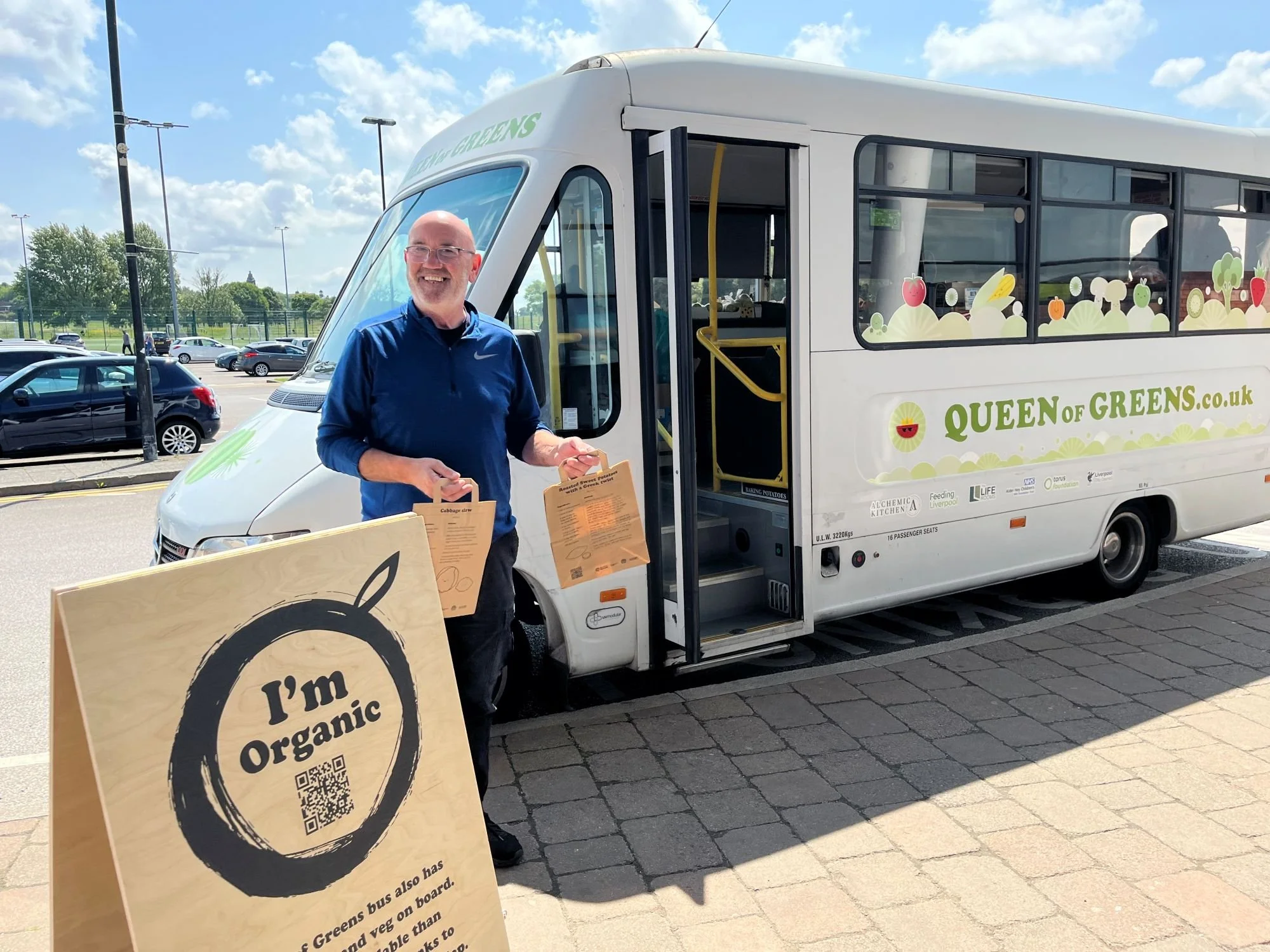
Antal gives the example of Stockbridge Village, an underserved area which has issues around health and long-term unemployment. It has a Nisa Local – but a price comparison reveals that an online shop at Waitrose would actually be cheaper, because Nisa mainly sells brands. Her solution to the food desert problem has been to take healthy food direct to the people. Antal is the founder of The Queen of Greens, a greengrocer on wheels that visits areas of Liverpool where she says it’s easier to buy a vape than an apple. Since 2024, the mobile grocer’s been offering organic produce too. Last year, it supplied 634kg of UK organic apples and 1,282.5kg of organic potatoes.
“We always say that we’re for everyone,” says Antal. “There’s no stigma attached to using our service. We don’t sell in packs, everything’s loose. So, if you literally just want one apple, one carrot, one potato, we’ll sell that to you. It’s not a problem. We stock fresh every day, and a lot of our customers tell us that it is better than the supermarkets because it lasts longer and is fresher.”
Food deserts may be a complex problem, but the answers are out there – and the independent sector has an important part to play. Blake says that the traditional solution proposed to alleviate food deserts has been to bolster the supply side – incentivizing retailers to locate in an underserved area or subsidize healthy food. Yet subsidizing demand can work too.
Demand-side solutions
Blake cites Fresh Street as a successful scheme which provides households with regular fruit and vegetable vouchers which are spent with local independents rather than supermarkets. “There’s no simple fix, but there’s a lot of potential in independent and community-owned shops,” says Ziegler-Jones. “They’re more than somewhere to buy food; they can be an important part of local infrastructure. A community-owned shop can keep a shop open on a high street that might otherwise lose it. Along with independent wholefood stores, they can more easily respond to what local people actually want to buy and give the community a stake in its own food supply.
“That’s where wholesalers have a role too. If we can make a genuinely broad range of nutritious, affordable food available to smaller independent retailers, co-ops and community shops, we’re helping them offer customers more choice without needing the buying power of a supermarket chain. Pulses, grains, tinned vegetables and other cupboard staples may not be glamorous, but making good, everyday food accessible is where you can make a real difference.”
By Matt Chittock, acting editor